Tuesday, April 17, 2018

Paschal moon: haiku to Percocet


Well, here’s a thing. My surgery appears to have gone well, but the attempt at a regional block was unsuccessful. So I had to have the dreaded general anesthesia. Also, the post-op pain is higher than I’d hoped (whole lotta nerves in the hand).

I submit in evidence, two crappy shots of my right arm. Soft cast goes up to my elbow.


My friends took me by Baskin Robins on the way home; so a milkshake was my first post-op meal.

Today’s entry is the worst one ever:

GWU surgery

Recovery pain;
Soft cast, fentanyl
Loopiness, milkshake

There’s a prescription for Percocet, but I’ve not got round to filling it.


Monday, April 16, 2018

Paschal Moon: pomegranate flower


There’s nothing like facing being cut open (even on an out-patient basis) to make one a little…introspective. So I’m turning to Rumi, the 13th Century Sufi mystic poet.

Last year I gave you “The Guest House” from him, instructing us to be a guest house to all the possibilities. This time the entry is another kind of invitation, one in keeping with Gratitude Monday.

“What Was Told, That”

What was said to the rose that made it open was said
to me here in my chest.

What was told the cypress that made it strong
and straight, what was

whispered the jasmine so it is what it is, whatever made
sugarcane sweet, whatever

was said to the inhabitants of the town of Chigil in
Turkestan that makes them

so handsome, whatever lets the pomegranate flower blush
like a human face, that is

being said to me now. I blush. Whatever put eloquence in
language, that’s happening here.

The great warehouse doors open; I fill with gratitude,
chewing a piece of sugarcane,

in love with the one to whom every that belongs!


Gratitude Monday: manual dexterity


Today I go in for surgery to treat basal joint arthritis. As my surgeon has explained it to me, he’ll remove the trapezium bone at the base of my thumb, extract part of a tendon in my arm (“which you don’t really need”) and bunch it up in the place of the missing bone.


(I’ve already cycled through all the other treatments—NSAIDs, a splint, cortisone.) I’d been putting this off, but the cortisone has stopped working, so that’s where I am.

I’m not looking forward to having my wrist in a cast—which you can’t get wet—for a month, and then in a splint for another one. But I’ve hit the point where the pain is pretty constant, and is midway along the scale; it’s also becoming increasingly difficult to do regular old things—use scissors, or a stapler; open or tighten jars; pour wine. (Passing platters around the table at Seder a couple of weeks ago was a crap shoot; I was relieved that I didn’t send brisket or soufflés flying onto my neighbors’ laps.)

I spent the weekend prepping the house for going a couple of months one-handed (and off-handed, at that; naturally this is on my dominant hand)—vacuuming, scrubbing the kitchen and bathrooms, laying in groceries that I can prepare without dipping my hand in them. (Dunno how that’s going to work, actually—I can’t make salad dressing without needing to be hosed off afterward.)

So what am I grateful for in all this? That there is treatment for this condition. My surgeon tells me that this is very successful surgery, and since I’ve exhausted all other treatments, it’s good to know that my chances are good with this.

I’m grateful that my surgeon is a very good communicator. After trying out two other orthopedic surgeons (both of whom seemed more interested in racking up insurance payments than in dealing with the condition), this guy is careful, clear and consistent. I believe I’m in good hands.

I’m grateful that I have insurance. It’s not stellar, but even so, it’s better than paying for this thing out of pocket.

I’m grateful that the surgery nurse is on the ball—she’s been competent and clear about what I need to do to prepare for this. She’s also made notes for the anesthesiologist to give me a little some-some to ward off post-op nausea and puking.

I’m grateful that friends will be on call to take me home afterward and get me settled. And I’m grateful that there’s an end in sight for all this pain.


Sunday, April 15, 2018

Paschal Moon: All these liberations


Today’s entries for National Poetry Month come from Audre Lorde. Early on Lorde found poetry her channel for communicating the complexities of being as intersectional as you can get: American-born to black Caribbean parents, lesbian, wife, activist, mother—basically an outsider no matter where she found herself at any given time. This may have been a reason why she continually defined herself in terms only of herself. 


In high school in New York City, Lorde participated in poetry workshops run by the Harlem Writers Guild, which she described as not accepting her because she was “both crazy and queer.”

At age 20, in 1954, she spent a year studying at the National University of Mexico; she returned to New York and graduated from Hunter College. She embarked on an academic career, teaching and writing, drawing on her experience as being “black, lesbian, mother, warrior, poet.” She held that binary divisions of male and female are simplistic, and that, while feminists have found it necessary to present a united front, there are many subdivisions of women.

Lorde’s poetry ranges everywhere she did; I’ll give you a couple of examples.

“Hanging Fire”

I am fourteen
and my skin has betrayed me   
the boy I cannot live without   
still sucks his thumb
in secret
how come my knees are
always so ashy
what if I die
before morning
and momma's in the bedroom   
with the door closed.

I have to learn how to dance   
in time for the next party   
my room is too small for me   
suppose I die before graduation   
they will sing sad melodies   
but finally
tell the truth about me
There is nothing I want to do   
and too much
that has to be done
and momma's in the bedroom   
with the door closed.

Nobody even stops to think   
about my side of it
I should have been on Math Team   
my marks were better than his   
why do I have to be
the one
wearing braces
I have nothing to wear tomorrow   
will I live long enough
to grow up
and momma's in the bedroom   
with the door closed.

“Who Said It Was Simple”

There are so many roots to the tree of anger   
that sometimes the branches shatter   
before they bear.

Sitting in Nedicks
the women rally before they march   
discussing the problematic girls   
they hire to make them free.
An almost white counterman passes   
a waiting brother to serve them first   
and the ladies neither notice nor reject   
the slighter pleasures of their slavery.   
But I who am bound by my mirror   
as well as my bed
see causes in colour
as well as sex

and sit here wondering   
which me will survive   
all these liberations.


Saturday, April 14, 2018

Paschal moon: bears, gowns & sarpints


Even though antics of the Klown Kar swirling around the White House provides sufficient laughs for a couple of decades, I think it’s time for something genuinely, harmlessly silly.

So, Edward Lear.


There was an Old Man on a hill,
Who seldom, if ever, stood still;
He ran up and down,
In his Grandmother’s gown,
Which adorned that Old Man on a hill.

(TBH, going all round the town in women’s clothes isn’t that much of a big deal where I come from. In fly-over country, though…)


There was an Old Man with a flute,
A sarpint ran into his boot;
But he played daay and night,
Till the sarpint took flight,
And avoided that man with a flute.

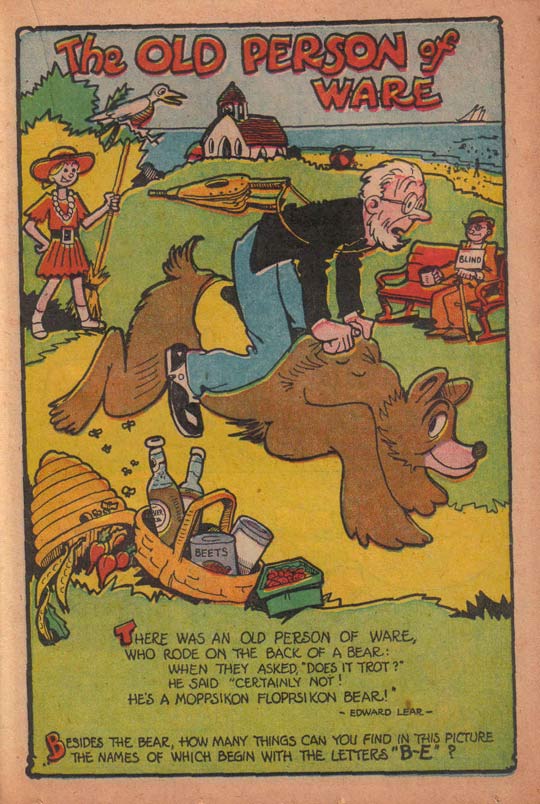
And here’s a version of the one about the Old Person from Ware (which my great-grandmother used to recite to us)—used in one of those periodicals for kids, Puzzle-Fun Comics, Spring 1946:


Friday, April 13, 2018

Paschal Moon: pacified rage


Friday the 13th is considered inauspicious by a lot of people. Those people are most likely also the ones who steer clear of black cats, broken mirrors and spilt salt.

That black cat one is weird. In many places, a black cat is considered a harbinger of good luck. (In England, weddings often include an appearance by a chimney sweep with a black cat on his shoulder, to ensure a happy marriage. I honestly don’t know about cats of any color riding around on anyone’s shoulder in a crowd of people hitting the champagne, but it’s definitely A Thing.) But in large swathes of Western Europe and the United States, black cats have a hard life. They’re often the first to be abandoned and the last to be adopted.

I don’t think I’ve done a poem by the Austrian-Czech poet Rainer Maria Rilke before. He’s quite fascinating, because he was basically in love with all the arts—sculpture, painting, music, writing; they all shaped his sensibilities. He traveled and lived all over Europe, soaking up what each community had to offer and adding the influences to his writing. He also had passionate relationships with a number of women of all ages, and managed to maintain good relationships with most of them.

So for Friday the 13th, let’s have Rilke’s “Black Cat”, whose beautiful fur absorbs all than a human can project, and in whose eyes turn us all into specks.

“Black Cat”

A ghost, though invisible, still is like a place
your sight can knock on, echoing; but here
within this thick black pelt, your strongest gaze
will be absorbed and utterly disappear:

just as a raving madman, when nothing else
can ease him, charges into his dark night
howling, pounds on the padded wall, and feels
the rage being taken in and pacified.

She seems to hide all looks that have ever fallen
into her, so that, like an audience,
she can look them over, menacing and sullen,
and curl to sleep with them. But all at once

as if awakened, she turns her face to yours;
and with a shock, you see yourself, tiny,
inside the golden amber of her eyeballs
suspended, like a prehistoric fly.


Thursday, April 12, 2018

Paschal moon: the thunder from Sinai


Yom HaShoah, the annual commemoration of the millions of lives lost in the Holocaust, began at sundown yesterday. At 1000 local time, everything will come to a halt across Israel, and people will stand silent and still, remembering those deaths. It’s an astonishing thing to watch on my computer screen; I cannot imagine it in real life.

(Possibly the two minutes of silence at 1100 on 11 November every year in the UK is the closest approximation. But in the years I lived there, I never saw the kind of universal participation—traffic kept moving, people chattered—so, no.)

Today’s poem for National Poetry Month is by Maria Skobtsova, née Elizaveta Yurievna Pilenko in 1891 in Riga, then part of Russia. She embraced atheism in her youth, married for the first time at age 20 (to a Bolshevik), and got involved with pre-war literary circles. For a while—during and after the Russian Revolution, Skobtsova had quite the adventurous life, including a planned assassination of Leon Trotsky, from which she was dissuaded by friends. Following her divorce, she was drawn to the (Orthodox) Church; she married a second time (to a man named Skobtsov), divorced this husband and moved to Paris with her children. The short version of this journey is that she took religious vows (assuming the name Maria) and found her calling in social work and theological studies. Her home became a center for refugees, geographic, economic and spiritual; her doors were open to anyone in need of help.

I don’t know whether it was a residue of her early years as an atheist, but somewhat unusually for a follower of Eastern Orthodoxy (the term “pogrom” and its practice originated in tsarist Russia), Skobtsova welcomed Jews to her refuge (without expectation of needing conversion), including during the time following the German invasion and occupation of France. Her spiritual advisor, Father Dmitri Klepenin, issued baptismal certificates to Jews, and she both sheltered those who came to her and helped many escape the country.

Eventually the Nazis came for her. In 1943 she was sent to Ravensbrück, the concentration camp for women, where she was gassed on 31 March 1945, five weeks before the end of the war. In 2004, the Eastern Church declared Skobtsova a saint; in 1985, she was recognized as Righteous among the Nations by Yad Vashem.

Skobtsova’s poetry covered a lot of ground, but for today I’ll give you this one.

“Israel”

Two triangles, a star,
The shield of King David, our forefather.
This is election, not offense.
The great path and not an evil.
Once more in a term fulfilled,
Once more roars the trumpet of the end;
And the fate of a great people
Once more is by the prophet proclaimed.
Thou art persecuted again, O Israel,
But what can human malice mean to thee,
who have heard the thunder from Sinai?


Wednesday, April 11, 2018

Paschal Moon: like a relic


The most common picture that comes to mind when we hear “First World War” is probably trenches snaking across Belgium and Northern France. We may have some vague notion of activities on the Eastern Front, or along the Dardanelles—or even Jerusalem and Damascus. But the war along the Italian Alps almost never makes the headlines (unless you’re a Hemingway fan).

And yet the Isonzo River was the scene of no fewer than twelve distinct, ghastly battles. Historian Mark Thompson sets the stage: “Imagine the flat or gently rolling horizon of Flanders tilting at 30 or 40 degrees, made of grey limestone that turns blinding white in summer.” And imagine the futility of launching attack after attack against entrenched fortifications across the seasons in that terrain.

From December 1915, Giuseppe Ungaretti served in the Brescia Brigade along the Isonzo—in his late 20s, he’d already absorbed the cultures of Egypt (where he was born to immigrants from Tuscany), Paris (where he went to study, and was influenced by Rimbaud, Apollinaire and other modernists) and Turin (where he’d trained to be a teacher). His poems are distilled down to the bare essence of his observations and experiences.

In today’s National Poetry Month entry, Ungaretti frames the confluence of the flow of his life in terms of the rivers symbolic of his experiences, converging on the Isonzo, which polishes him like a stone. It was written in August, 1916.

“Rivers”

I cling to this mangled tree
Left to lie in the crevasse
That has all the indolence
Of a circus
Before or after the show
And I watch
The tranquil passing
Of clouds across the moon.
This morning
I stretched out
In an urn of water
And like a relic
Rested.

The Isonzo rushing
Polished me
As one of its stones.

I pulled
My bones together
And off I went
On the water
Like an acrobat.

I squatted down
Beside my clothes
Filthy with war and like a Bedouin
I bowed to receive
The sun
This is the Isonzo
And here I best
Acknowledged myself
A pliant fiber
In the Universe.

My torment
Comes when
I think myself
Out of harmony. But those hidden Hands
That immerse me
Give me freely
An uncommon
Happiness.
I have gone
Through the stages
Of my life

These are my rivers.

This is the Serchio
From which perhaps two thousand
Years of my own country folk
And my father and my mother
Have drawn their water

This is the Nile
That saw me born
And saw me grow
In unawareness
On the expansive plains.

This is the Seine
And in its swirl I mingled
And I came to know myself

These are my rivers
Tallied in the Isonzo.

This is my nostalgia
That in each of them
It comes to me
Now that night has fallen
That my life to me seems
A flower
Of shadows.


Tuesday, April 10, 2018

Paschal moon: miracle and cures and healing wells


Today’s entry for National Poetry Month comes from Seámus Heaney. Two years ago I gave you his heartbreaking “Requiem for the Croppies”, and mentioned his linguistic mastery, which included lyrical translations from Irish, Latin and Greek. For this round, I’ve chosen “The Cure at Troy”, which is Heaney’s take on Sophocles’ Philoctetes.

All you need to know about Philoctetes is that he was one of the approximately 72 squillion suitors for Helen, and thus honor-bound to help Menelaus retrieve her from Troy. He was stranded on the island of Lemnos on the way (different versions give different reasons, but all seem to involve some kind of suppurating wound whose putrescence offended the Greeks). After many years of siege, the Greeks were told they wouldn’t win the war until they possessed the weapons of Heracles, which were…on Lemnos. As you might imagine, Philoctetes (reduced to a solitary animal-like existence in the intervening time) wasn’t exactly overjoyed at the prospect of handing over the sacred weapons to the very men who’d abandoned him (he was particularly pissed off at Odysseus), but Heracles appeared and told him to give up the artifacts and his wound would be healed by Asclepius, and he would become a great hero, a key driver of winning the war. (Some versions have him killing Paris, the little toerag who started the whole thing; others put him in the actual Trojan Horse. Either way he was instrumental in driving a stake through it.)

So there are a lot of symbolic moving parts to this one—the festering wound that won’t heal and leads to the debasement of a warrior; only by a series of redemptive decisions is he given a permanent cure, which leads to the end of a long, exhausting war.

Heaney wrote his version in 1990 as a tribute to Nelson Mandela, and an indictment of apartheid. (Its relevance to the situation in Northern Ireland is also obvious.) Note that—like Mandela—Heaney urges the reader to move beyond revenge, to the “further shore” with “cures and healing wells.” I believe these are thoughts we should keep before us in these times.

“The Cure at Troy”

Human beings suffer,
They torture one another,
They get hurt and get hard,
No poem or play or song
Can fully right a wrong
Inflicted and endured.

The innocent in gaols
Beat on their bars together.
A hunger-striker’s father
Stands in the graveyard dumb.
The police widow in veils
Faints at the funeral home.

History says, don’t hope
On this side of the grave.
But then, once in a lifetime
The longed-for tidal wave
Of justice can rise up,
And hope and history rhyme.

So hope for a great sea-change
On the far side of revenge.
Believe that further shore
Is reachable from here.
Believe in miracle
And cures and healing wells.

Call miracle self-healing:
The utter, self-revealing
Double-take of feeling.
If there’s fire on the mountain
Or lightning and storm
And a god speaks from the sky

That means someone is hearing
The outcry and the birth-cry
Of new life at its term.


Monday, April 9, 2018

Paschal Moon: uninvited stain


My National Poetry Month entry today is by Mary P. Pettigrew, a woman who lives with Multiple Sclerosis, who could have been any of the participants I’ve seen in the WalkMS events I’vebeen to.

In another poem, about Annette Funicello, Pettigrew refers to sufferers as members of the MSketeer Club. This one is about the internal workings of the disease.

“Scars”

This brain, my brain
Reveals an unwanted, uninvited stain
Stealthy invaders placed an ugly mark
Though visually unseen, it's there...a permanent scar.

A tattoo, if you will
An indelible marking, perplexing until
Courageous, yet daunting intervention begins
Presenting theoretical ideas, invasive needles and pins.
The monster's mastery takes hold, you see...
Internally stalking, exploring ways to manipulate me
Wicked, determined to strike and knock me down
A bully in hiding, deploying trickery like a devious clown.
This brain, my brain
With this extraordinary, devastating stain
Brings clarity, unexpected strength, possibility
Now, determined, striving to re-define my disability.