Wednesday, November 12, 2014

The prime of our land

On Sunday I mentioned that there’s a traditional set of music played at the Remembrance Sunday ceremony held every year in Whitehall. For some reason I’ve had a couple of the regulars floating in my head since then, so I’m sharing with you.

You’ll recall that “It’s a Long Way to Tipperary” is in honor of the Connaught Rangers. I’ve always liked this song; perhaps because it didn’t originate as a military march. It was actually written to be performed in music halls (basically the British version of Vaudeville; even though Vaudeville is before my time, I’ve seen Marx Brothers movies and therefore I know the drill)—so, meant to be lively, raucous and sung-along with. It predates the outbreak of World War I by two years, and became quite popular during the war.


The connection to the Rangers is that in mid-August 1914 a Daily Mail correspondent observed the regiment singing it as they marched through Boulogne. Apparently this was the first instance of British soldiers singing it (at least in front of reporters), so it stuck with the Rangers; although it did spread through the British Army, and (later) the American as well.

(As a sidebar, this song is associated in my mind with the first, very elaborate and elongated pun I can remember hearing. It cracked me up no end, I assure you, notwithstanding its rather mournful end, and I still laugh at it. But I won’t repeat it because it’s somewhat along the lines of elephant jokes and I’m pretending we’ve risen above that sort of thing.)

Its music hall roots may explain some of “Tipperary’s” popularity. Unlike a lot of songs written specifically for soldiers heading off to wars, there’s nothing at all martial about it. It’s all about home, and hopes of returning there. There’s longing, of course, but the upbeat tempo prevents it from getting sloppy. It’s a great tune for stepping lively, even if you’re schlepping a 65-pound pack on your back.

The other piece I’ll “play” for you is “Flowers of the Forest”, such an extraordinarily powerful lament that I don’t think you need the lyrics to understand the sorrow it expresses. The melody dates from at least the 17th Century, and lyrics were added in the 18th marking the Scots fallen at the Battle of Flodden Field. (Killed by English soldiers, but we won’t go into that right now.)


Because Highland regiments formed the backbone of the British army in so many wars over the centuries, what started out as a lament for Scots slain by Englishmen has been transmuted to a universal piece that accompanies the bodies of British soldiers home from the battlefield. It has had rather a workout in recent years, as it marked British and Canadian deaths in Afghanistan.

I understand that many pipers only perform it in public at funerals.

And at services on Remembrance Sunday.


Tuesday, November 11, 2014

On watch

For Veteran’s Day, my offering to you is visual—members of the 3rd Infantry Regiment standing watch over the Tomb of the Unknowns at Arlington National Cemetery.


They do it around the clock and every day of the year, regardless of the weather, as you can see.

There are plenty of videos of the changing of the guard, which is indeed a moving ceremony. But I like the image of the lone sentinel standing watch over the dead, no matter what the weather.(And from the YouTube information I'm kind of extrapolating that a mother shot it of her son.)

Yeah—I’d rather we spent money to send our men and women into harm’s way with the best equipment and protective gear, and then give them adequate medical care and emotional support when they return to The World. And it pains me that, even as they were placing the first Unknown in the tomb in 1921, we as a nation have fallen short on this (with the possible exception of World War II).

But I also recognize the symbolic value of this ritual. It is beautiful to watch—peaceful, reassuring somehow. Those measured steps, the pauses, the focus.

I also find the placement of the tomb exquisitely appropriate, as you look beyond it onto the city of D.C. Which means that the Unknowns—and their sentinels—are metaphorically watching over our seat of government. However high or low regard you may have for the current components of that government, it’s rather nice to know that these soldiers are still doing the job they signed on to do.


Monday, November 10, 2014

Gratitude Monday: Bridges of art

It’s Gratitude Monday, between Remembrance Sunday and Veterans Day, so here’s what I’m grateful for today: Installation art.

Yeah, you heard me—I’m going back to my roots in the humanities and am grateful for installation art projects that help us get our heads around losses that simultaneously crush us with grief and render us completely unable to understand their magnitude.

Let me give you some examples.

The AIDS Memorial Quilt, AKA The NAMES Project. It’s a collection of more than 48,000 3’x6’ panels, each representing the life of one person who died of AIDS. Friends and family created each panel, embroidering, appliqueing, painting—however they wanted to depict what was important to them about the one they lost.

Panels were combined in groups of eight to form blocks. The first panel was made in 1987, in San Francisco. By the time I saw the Quilt in DC in 1996, those blocks covered the entire National Mall. There is a display ceremony—volunteers rotate the blocks before laying them on the ground—so there’s a stylized movement to the installation. And then there are those who line up to read the names of the lost over the PA system.


Nearly 20 years on I can still recall the woman’s clear, strong voice, as she read out her apportioned list, ending with, “And my magnificent son…” I don’t remember the name, just how her love and loss seemed to fill the autumn air all across that space.

It was also something to see how the Mall visitors responded to the Quilt, the looks on their faces as they took in each panel, each person represented in fabric, thread and photos. And then, the view along the Mall completely under those blocks, like a child asleep under a handmade quilt.

*  *  *  *  *

In 1998, the kids at Whitwell Middle School, in Whitwell, Tennessee, were learning about that most elusive of civic-social concepts, tolerance. What better example to use for what happens when society fails to exercise tolerance than the Holocaust?

Only—six million people? What does six million even mean?

In a community of 1500 souls, the children couldn’t grasp that kind of number. So they decided they needed to collect six million of something, to help them get their heads around how many people had been murdered. They chose paper clips, because they found out that Norwegians wore paperclips on their clothes to protest the Nazi occupation.

The Paper Clip Project expanded as they wrote to public figures and news outlets took up their quest. Eventually they acquired one of the boxcars that had been used in deportations, installed it next to the middle school, and filled it with 11 million paperclips, which number includes other groups specifically targeted for destruction by the Nazis, like the Roma, homosexuals and Jehovah’s Witnesses.

The Whitwell Children’s Holocaust Memorial was dedicated on 9 November, 2001. It encompasses the paperclips and historical artifacts and mementos the kids collected over the course of reaching out across the world in their quest to understand the loss that policies of intolerance creates.


A local artist also installed a variety of metal butterflies around the boxcar. These tie in directly with the collection of poems and art created by children in the TerezĂ­n transit camp. And also—butterflies are such a powerful symbol of transformation and rebirth.


This project connected the young people of a tiny, backwater, largely homogeneous town with Holocaust survivors, historians and children around the world. But beyond that, the way they depicted what devastation results when intolerance is raised to policy is a stunningly clear and vivid presentation.

*  *  *  *  *

And, of course, the installation at the Tower of London, “Blood Swept Lands and Seas of Red”. Each ceramic poppy represents a British or Commonwealth soldier who died in the First World War. Each one is exquisitely beautiful: bright and brilliant and shiny as youthful hopes. Each one is unique, as was every life lost.


And there are 888,246 of them.

As I’ve said, it’s when the individual poppies are planted next to one another in their hundreds of thousands, they become a visual ocean of blood. They swell over the Tower’s dry moat, almost reaching up into the nearby streets.


And here’s the thing: in each of these examples, it’s art that lets us see all at once the individual and collective loss. One panel, one paperclip, one poppy; added to ten, to a thousand, a million—what was a tragedy for a family becomes the depletion of a nation and a shift in the course of history. But without the panels and blocks, paperclips and butterflies or waves of poppies, we as individuals and communities can only take in a single dimension at a time. If that.

So I am deeply grateful for the installation artists who are able to evoke the individual and the mass in showing us the consequences of our actions as individuals and as nations. They make the impossible visible and invite us to take it all in.

And, maybe, to learn from it.


Sunday, November 9, 2014

Red for remembrance

Here are some of my favorite images from today’s Remembrance Sunday observance in Britain:

Chelsea Pensioners during the march-past at the Cenotaph in Whitehall:


Falling poppies projected onto the tower of the Palace of Westminster (the one with Big Ben in it):


The “Blood Swept Lands and Seas of Red” installation at the Tower of London, completely filling the dry moat, and with personal markers of loss left by visitors:


Poppy crosses with photos of service members killed in Afghanistan, in Edinburgh:


Blood-swept remembrance

Today is Remembrance Sunday in the UK, and although the occasion honors all those who’ve served in Britain’s military branches, it’s inextricably tied to the trauma of the First World War. It’s the nearest Sunday to 11 November, on which day in 1918 an armistice went into effect between the Central Powers (Germany, Austria-Hungary and Turkey, mostly) and the Allied Powers (France, Britain, America and Italy, sort of).

(By this time Russia had been out of the war for a year.)

On Tuesday, the 96th anniversary of the Armistice, there will be two minutes of silence at 1100, and muffled bells will toll from church towers across the country, before pre-holiday normal life resumes. This is known as Remembrance Day.

This being the centenary of the beginning of that war, the connections are perhaps more clearly defined than in past years. You can see this in the poppy theme.

Poppies have been associated with remembering the dead of World War I since Canadian John McCrae wrote the poem “In Flanders Fields”, about the blood-red wildflowers that bloomed in the blasted landscapes of Northern France, where the dead and dismembered lay in their tens of thousands. It begins:

“In Flanders fields the poppies blow
Between the crosses, row on row”

McCrea, a field surgeon with life-long respiratory problems, wrote it in 1915. He died of pneumonia in January 1918 in Boulogne, age 46. But his imagery of the flowing poppies covering the naked dead captured something that enabled those left behind to visibly honor their loss. The Royal British Legion has used their Poppy Appeal to raise funds since 1921 (a year after the National American Legion adopted it as their commemoration).


This year, the symbolism grew exponentially with the art installation of “Blood Swept Lands and Seas of Red”: 888,246 ceramic red ceramic poppies falling from a bastion window in the Tower of London and spreading around the dry moat. Each poppy represents a single death of British and Commonwealth soldiers. Collectively they are waves of blood that almost overflow the moat.


Since its installation on 4 August (the centenary of Britain’s declaration of war against Germany), more than four million people have visited the memorial, very often in stunned silence. Because it’s so hard to envision numbers like 900,000, to understand the magnitude of the loss they define. But seeing that number of individual ceramic flowers merge into the seemingly endless flow of crimson—that can stop you in your tracks.


(On the night of 4 August, homes and business around the country replaced the brilliance of electric lights with the flickering and tenuous glow of candles, representing the observation that with those declarations, “The lamps are going out all over Europe. We shall not see them lit again in our life-time.” The photographs of the commemoration catch you somewhere between the throat and the heart.)

When viewed from the air, you can see how much the dry moat truly looks like a sea of blood.


Today there will be a ceremony at Whitehall, with two minutes of silence as Big Ben strikes eleven times and a field gun on Horse Guards Parade fires. “The Last Post” will sound, and the Queen and politicians from the former empire will lay wreaths of poppies on the Cenotaph, the empty tomb erected in 1920.


Bands will play “Heart of Oak”, “Flowers of the Forest”, “Men of Harlech”, “The Minstrel Boy” and other such. This music list was set in 1930, and they’ve played it ever since.

Then there will be a march-past of veterans from the wars of the 20th and 21st centuries—none left now from World War I, and not so many from World War II. (Well, when I say “march”, many of them will be in wheelchairs, but they wouldn’t miss it for anything.) This year I hope their ranks will be swelled by the troops who recently departed Camp Bastion, ending Britain's 13-year combat mission in Afghanistan.


There’s more music for this, and I especially like them including “It’s a Long Way to Tipperary”, the marching song of the Connaught Rangers, one of the many Irish regiments that served the Empire (in their case, from 1793 to 1922, when the Irish Free State rendered that service illogical).

Meanwhile, over in Cookham, my friend Marcia will be tolling the tenor bell (muffled) at Holy Trinity in the 15 minutes leading up to 1100—“It has to be done slowly,” she said, “practically setting the bell at both handstroke and backstroke.” She does it every year. As do hundreds more around Britain.

Poppies, muffled bells, the creaking of joints unaccustomed to walking to a cadence; the Windsors out in force (and protective services out in force); private visits to village monuments with the names of boys whose lives ended on the brink of manhood, at the edge of a trench. They didn’t realize when they erected those monuments that there would be another 95 years’ worth of names of those killed on beaches, deserts, mountains and jungles to be accommodated.

Much as they didn’t realize world wars would need to be numbered.

They’ll dismantle the installation at the Tower later this month; some of it will eventually be on display at the Imperial War Museum, which was created to document Britain’s wars of the 20th Century. But next November the Remembrance ceremonies will be held again. And the next and the next after that.


Friday, November 7, 2014

Post-election blues

For some reason, the outcome of Tuesday’s elections makes me think of the most recent Viagra commercial being run by Pfizer.


Because there are a whole lotta new officeholders who are going to want to show who’s got the biggest appendage. And I expect that many of them will require some chemical enhancement.

I found this commercial bizarre—advertising the treatment for a middle-aged man’s dysfunction by showing nothing but a 20-something blonde bimbo with a British accent.

At first I thought it must be a parody, because…well, because it’s even dorkier than the Cialis twin bathtubs in the sunset. 

But then I realized that the target market for Vitamin V is precisely the middle-aged male looking to recapture his (possibly imagined) youth by disporting with endless bimbos. So I suppose never actually showing a, you know, guy with some years on him opens up everyone’s imagination.

I pretty much lost it toward the end, though, with this shot:


Nothing soft-sell about this pitch, is there?

Anyhow, I’m sure that all the newly-elected pols up and down the scale have health insurance that will cover all the little blue pills they could want. Since we’re talking the opposite of birth control.


Thursday, November 6, 2014

Don't drive like my brother

Like millions of NPR listeners, I was truly saddened to hear of the death Monday of Tom Magliozzi, half of Click and Clack, the Tappet Brothers of Car Talk. He was 77.

How do I explain Car Talk to those who’ve never heard it? It’s kind of a call-in radio show, mostly about motor vehicles (sort of), but laced with a lot of commentary on life and massive infusions of laughter. Tom and his brother Ray had been doing a version of the program from WBUR in Boston since 1977.

I’ve been listening to it since the 80s, and I don’t like call-in programming and I don’t care much about cars. But I loved Tom and Ray, who had laughs that would cure the common cold.

You can read about the Magliozzis and Car Talk in several stories on NPR. What’s interesting about them is the comments: This is the first time I think I’ve ever seen any online content, no matter how seemingly innocuous (dog reunited with family, flowers planted along a highway, man emerges from 40-year coma) that didn’t engender at least 15% of mean, political or just plain crack-brained contributions by those with Internet access and a keyboard.

But take a look at any of NPR’s stories, and every single comment (as of time of writing) is about how much Tom (and Ray) brightened our weekend days, year after year. People proudly proclaim that they don’t drive and don’t give a toss about cars, but they tuned in regularly because Tom and Ray just sucked us in to a better world, where there was a solution to your problems—mostly car-related—even if it might involve a Viking funeral. Even commenters who regularly spew ideological bile and political vituperation on those innocuous stories here post nothing but sadness at Tom’s loss and happy memories of his broadcasts.

If you never heard them, I’m truly sorry for you. Go stream some of the shows—although the best way to listen to Click and Clack is to be driving around on your weekend errands, laughing and slapping your steering column like a demented seal, and be forced to park somewhere so you can hear out the program to the very end of their wacky credits.

Car Talk stopped original broadcasts two years ago, but NPR has been airing older shows since then. Because it’s not really so much about calling in to sort your 1998 Nissan Sentra’s whoop-whoop-whoop noise it makes when you turn left at 35 MPH as it is listening to these guys…well, just listening to them.

In such an unexpected way, the Magliozzis spread joy, with the pretext of diagnosing and solving mechanical problems. There’s so little of that around these days, so I’m glad that they’ve been part of my weekends for nearly 30 years.


Wednesday, November 5, 2014

Remember the tiggies

Apparently there are health and safety issues inherent when you’re building bonfires to celebrate the suppression of religious minorities, as people will be doing all over the UK tonight.

(Oh, alright—officially Guy Fawkes Day is about the foiling of a plot to blow up Parliament in 1605. And the plotters were Roman Catholic. Which gave Church of England Protestants reasons to stick it to Catholics in particular and everyone who wasn’t CoE in general for centuries to come. This evolved into the Bonfire Night activities of today.)

So, yes—check under your pile of wood for any cute little critters that might be inadvertently char-be-cued in your death-to-Catholics ritual.


I expect the danger to humans increases with the consumption of alcohol, as well. But the health and safety folks probably reckon that the lager lout crowd won’t be reading caution posters, so they don’t bother with them.


Tuesday, November 4, 2014

Getting out the vote

It's election Tuesday. As with all such days, it's a major relief to know that holiday ads will replace the political commercials on TV. 

Case in point: They’ve been running a lot of anti-Prop 45 commercials on TV. (Proposition 45 is an initiative requiring that insurance companies get approval from a state commissioner before they make any changes affecting the rates they charge for healthcare coverage.) Their scare campaign revolves around someone dressed up as a physician or nurse intoning that letting a politician mess with healthcare decisions that should be made only by the doctor and the patient is a very, very bad, horrible, terrible thing.


I’ve no doubt that the anti-Prop 45 campaign can afford these ads; it’s extremely well-funded. Its backers include: the California Hospital Association, California Medical Association, and healthcare insurance giants like Anthem, Kaiser, Blue Shield and United HealthCare. That latter group alone have more money than God, in case you’re at all unclear about the matter. As of a couple of weeks ago, they’d spent more than $57M to defeat the measure.

(Of course, you could sweep out $57M from between the sofa cushions in the executive lounge of any of those insurance companies. But still.)

What I find interesting about this “Healthcare decisions should be made by doctors, nurses and patients—not dictated by one Sacramento politician” rhetoric is the foundational logic that this is currently the case. You know, that medical decisions are made only by the physician and patient.

When, in practice, this is a complete crock of moosemilk.

Under the prevailing payment model, healthcare decisions are in fact made by insurance carriers. Both directly—in terms of what they deem is appropriate (meaning “what we’ll reimburse you for”) treatment, as well as indirectly because providers are driven to see three or four patients per hour under terms of their insurance contracts, so they don’t have the time to properly understand patients’ needs, histories or ailments in order to make truly informed decisions.

You know—just the fact that Anthem is coughing up the kale is pretty much all I need to know about the merits of the anti-45 argument. We’ll see how successful they are at gulling the electorate.

*           *           *           *
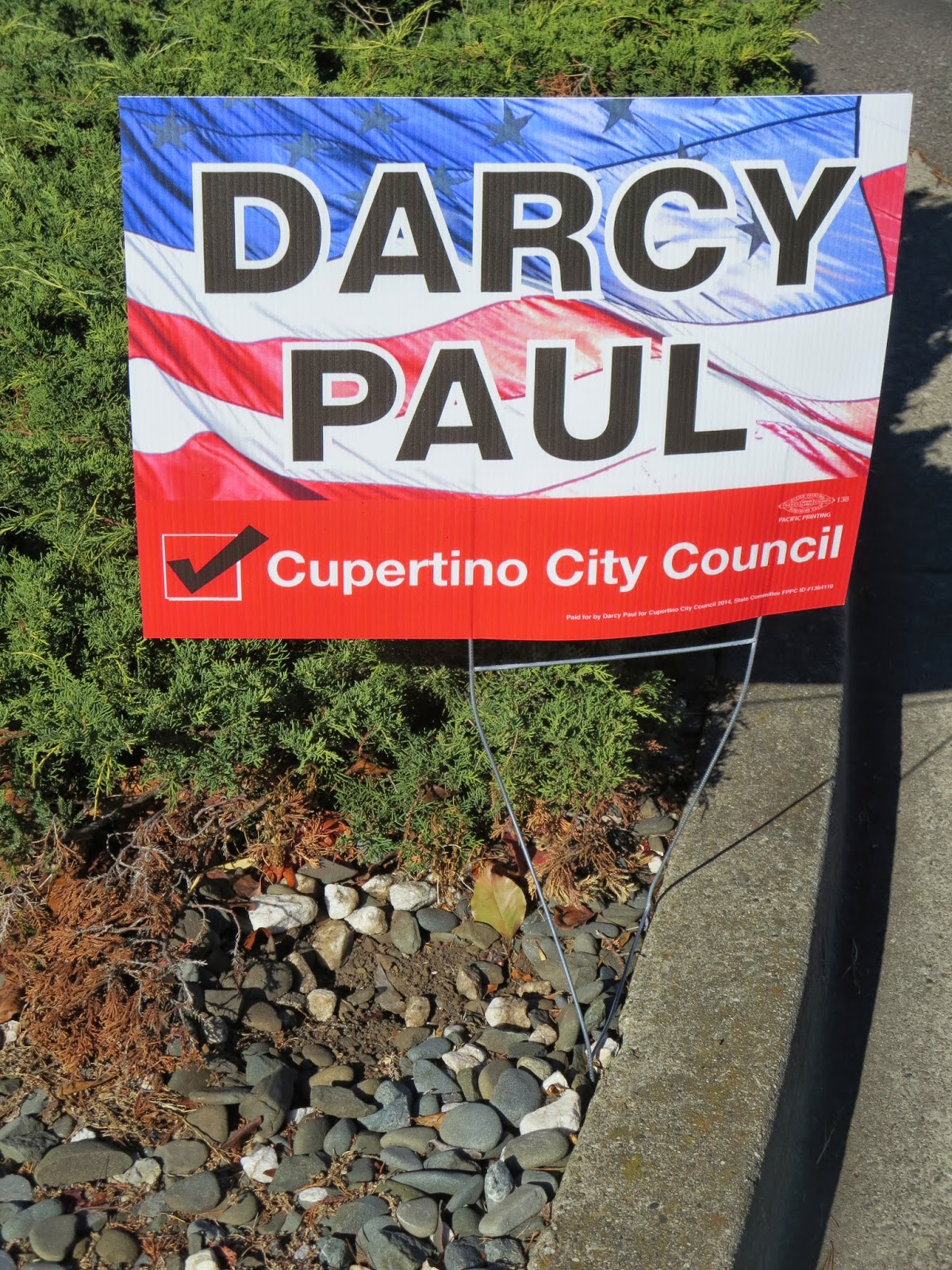
Also on an electoral theme, I noticed these signs for Cupertino City Council candidates.


Cupertino, as you may know, is the home of Apple. That’s where their physical headquarters are, I mean; I think most of their revenues are filtered through offices in other countries, so that their tax liability here in the US, California and Cupertino is considerably smaller that you’d have expected from their sales figures.

Anyhow—here’s the sign I found particularly interesting:


Andy clearly wants the electorate to think of him by his all-American first name, not his surname. In a city where the electorate is 44.4% Asian, I just wonder what’s up with that, because it obviously doesn't bother either Paul or Sun.


Monday, November 3, 2014

Gratitude Monday: Books by the bed

By way of illustrating what I’m grateful for today, I give you…everything I need for snuggling in for the night:


The pile of books on the left comprises several I own, including my two most recent acquisitions, on the British Commandos of World War II. Look, sometimes a bit of light garroting and timed explosives is just what a girl needs before dropping off to sleep.

The stack on the right is books I currently have checked out from the various library systems here in the Valley They Call Silicon. Depending on the subject matter, I plough through two to five per week. This bunch includes a couple of Judge Dee mysteries (which I don’t particularly recommend), the new biography of Elsa Schiaparelli (ditto), several histories (World War I, and the Gurkhas), a collection of Dick Cavett's columns for the NY Times and a deconstruction of wit. 

Many of the books I read have been recommended by friends. About a third of the present occupants of the surface came to me that way. Several—permanent fixtures beside my bed—are gifts, to which I return often by way of connecting with the friend who gave them.

Then there are scraps of paper I use for jotting down pithy phrases or reminders of things I need to do. (Actually, they’re from the Santa Clara County Library; they’re what mark the books they’re holding for pick-up. Each one is a third of letter-sized paper, and they’re only written on one side. Perfect for scratch paper, as my thoughts are not generally Dostoyevskian in length. Or, now that I think of it, in depth. Um.)

And the bookmarks—almost all of which are also from friends, although I noticed one from Hatchard’s Booksellers, marking their 200th anniversary.

There was a time when I didn’t actually need no stinkin’ bookmark; I could remember where I’d left off when I returned to a book. But that time, alas, is long past.

Anyway—I’m grateful for the pleasure that having stacks of books right by my bed gives me, and for the connections they continually weave with my friends.